
30 Million Downloads, One Very Hasty U-Turn: Remembering Wuthering Waves’ Glorious Fumble
Wuthering Waves marked 30 million downloads with a lottery that enraged players, then quickly awarded all players ten free pulls.
In the sweltering gaming summer of 2024, Wuthering Waves burst onto the scene like a grizzly bear that had just woken from hibernation—lumbering, slightly confused, but undeniably massive. Within roughly two and a half weeks of its May 22nd launch, Kuro Games’ open-world gacha title clocked an astonishing 30 million global downloads. For context, that’s more downloads than the entire population of Australia deciding to install a game in the time it takes to binge-watch a single anime season. Naturally, the developers wanted to celebrate, and what better way than to hand out free pulls? What followed, however, was a masterclass in how a well-meaning gesture can turn into a community relations fire drill.
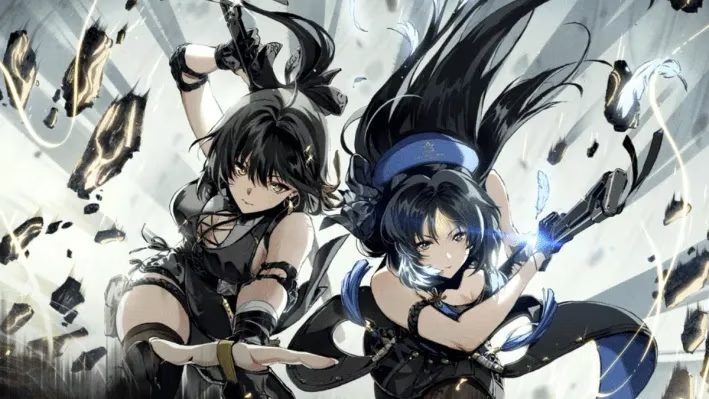
The original plan was a lottery. Ten Lustrous Tides—essentially ten pulls on the gacha banners—would be raffled off to ten lucky players. For a moment, imagine a bakery announcing a free cake giveaway but only handing one slice to a single customer while 29,999,999 others watch through the window. The player base’s reaction was swift and predictable: the kind of collective groan that could be heard from the server rooms in Tokyo all the way to the social media trenches of Twitter. Within hours, the developers pivoted faster than a startled cat on a marble floor. The lottery evaporated. In its place, everyone who logged in would receive ten Lustrous Tides and five Crystal Solvents straight to their in-game mailbox. A redemption arc so abrupt it could give whiplash.
But this wasn’t the only time Kuro Games proved they were listening with the intensity of a submarine sonar operator. The launch state of Wuthering Waves was, to put it charitably, a parade of technical gremlins. Frame rate hiccups, localization that occasionally read like it had been translated by a confused AI that had only ever studied fortune cookies, and a user interface that sometimes felt like it required a pilot’s license. Yet, patch after patch, hotfix after hotfix, the studio demonstrated a stubborn willingness to take feedback and act on it. They didn’t just nod politely at complaints; they practically strapped a rocket to their to-do list and launched it towards the first available patch window.
One of the more eyebrow-raising moments involved the character Scar, a major antagonist whose original design became a lightning rod for debate. His initial appearance had an uncanny ability to unite players in a single question: “Who dressed this man?” The visual update that followed was like swapping out a Halloween costume that arrived from a suspiciously cheap online store for a tailored suit. It arrived alongside the unexpected speed-up of Yinlin’s character banner, a move that felt like the developers had read the community’s collective mind and decided to fast-forward their own schedule just to keep the momentum alive. It was as if someone in the control room had their hand permanently hovering over a big red button labelled “launch Yinlin immediately,” and finally slammed it with a satisfied grin.
Now, in 2026, two years after that chaotic yet oddly charming debut, the 30-million-download milestone feels like a distant but beloved memory. Wuthering Waves has grown into a polished, combat-heavy powerhouse that no longer lives in the shadow of its obvious inspiration. The early hotfixes have evolved into a full-blown content pipeline that includes new regions, Echo systems so deep they practically require an archaeological degree to master, and character designs that range from elegant to “how many belts is too many belts?” What remains unchanged, however, is the developer’s almost reflexive need to course-correct when the player base speaks.
The Lustrous Tide giveaway fiasco has become a community legend, retold whenever someone suggests a raffle in a gacha game. It serves as a cautionary parable: if you promise treasure to your entire crew but only hand one map to a random stowaway, prepare for a mutiny. The subsequent make-good gesture may have been a frantic U-turn, but it established a pattern that would define Kuro Games for the next two years—treat your players like shareholders in the fun, and they’ll stick around even when the servers catch fire.
By 2026 standards, Wuthering Waves’ launch troubles are practically nostalgic. The game now sits comfortably on Windows PCs and mobile devices with a stability that would be unrecognizable to its early adopters. The trust built during those first two and a half weeks—and the 30 million downloads that made the whole industry blink—is a testament to a simple truth: in the world of live-service games, a developer who can admit a mistake and hand out freebies like candy on Halloween is worth more than a flawless launch day dressed in silence.